
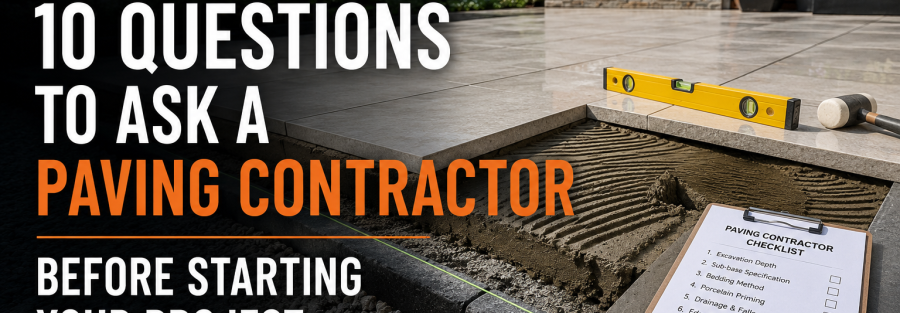
What Questions Should I Ask a Paving Contractor? Natural stone and porcelain paving represent a significant investment. Yet many paving failures have very little to do with the paving itself. More often than not, the failure can be traced back to decisions made long before the first slab was laid.
The questions you ask before appointing a contractor are often more important than the quotation itself. A competent contractor should not only be able to answer these questions but also explain the engineering principles behind each decision.
Here are ten technical questions every client should consider before proceeding with a paving project.
1. What Excavation Depth Have You Allowed For, and How Was It Determined?
One of the first questions should concern excavation depth.
Excavation should never be based on habit or a “standard detail.” It should be determined by site-specific conditions including soil bearing capacity, anticipated loading, frost susceptibility, drainage characteristics and the overall pavement construction.
A contractor who cannot explain why they have chosen a particular excavation depth is relying on experience alone rather than technical assessment.
2. How Have You Determined the Required Sub-Base Specification?
Sub-base is often referred to as the foundation of a paving installation, yet its specification is frequently misunderstood.
Questions worth asking include:
- What material will be used?
- What layer thickness has been specified?
- How will it be compacted?
- How many compaction passes will be undertaken?
- Will moisture content be considered during compaction?
Compaction is not simply about running a plate compactor over the surface. Proper compaction requires appropriate lift thicknesses, suitable equipment and consistent methodology throughout the construction.
3. What Bedding System Will Be Used?
Not all bedding systems perform equally.
A full wet mortar bed provides continuous support beneath each paving unit and significantly reduces the likelihood of voids beneath the slabs.
Spot bedding or ribbon bedding may reduce installation time, but unsupported areas can create stress concentrations that increase the likelihood of movement, rocking or cracking.
Ask your contractor why they have selected their chosen bedding method rather than simply asking what they use.
4. How Will Bond Strength Be Achieved With Porcelain Paving?
Porcelain presents unique challenges because of its extremely low water absorption.
Simply laying porcelain onto mortar is not sufficient.
A suitable slurry primer should be applied to the reverse of every slab immediately before installation to create a reliable bond between the bedding mortar and the paving unit.
A contractor should be able to explain:
- the primer they use,
- why it is required,
- and their application procedure.
5. How Has Surface Water Management Been Designed?
Surface water management should never be treated as an afterthought.
The contractor should be able to explain:
- proposed falls,
- drainage strategy,
- discharge locations,
- compliance with local drainage requirements,
- and whether Sustainable Drainage Systems (SuDS) principles have been considered.
Water should always be managed deliberately rather than simply directed towards the nearest low point.
(External reference: CIRIA SuDS Manual.)
6. How Will Edge Restraints Be Constructed?
Every paving installation relies upon effective edge restraint.
Without adequate restraint, lateral movement within the pavement structure becomes increasingly likely over time.
Questions worth asking include:
- How will kerbs be restrained?
- Will concrete haunching be used?
- How will transitions between paving and soft landscaping be supported?
Edge restraint is one of the least visible elements of a project, yet one of the most important.
7. How Will Movement Be Accommodated?
All paving systems experience movement.
Thermal expansion, moisture variation and minor ground movement all place stress upon rigid paved surfaces.
The contractor should be able to explain:
- joint widths,
- movement joints,
- interfaces with buildings,
- and how differential movement has been considered within the overall design.
Ignoring movement does not prevent movement.
It merely changes where failure eventually occurs.
8. How Will Levels and Falls Be Verified During Construction?
Finished levels should never rely solely upon visual judgement.
Professional installation should include continuous verification using appropriate surveying equipment throughout construction.
The contractor should be able to explain:
- how datum levels are established,
- how falls are checked,
- and how tolerances are maintained across the paved surface.
Minor errors at this stage often become highly visible once the project is complete.
9. What Is Your Procedure When Existing Ground Conditions Differ From Expectations?
Ground investigation is limited until excavation begins.
Buried foundations, tree roots, soft ground, historic drainage and undocumented services can all affect construction.
A competent contractor should explain how unforeseen conditions will be assessed, documented and communicated before additional work proceeds.
Transparent communication is often a better indicator of professionalism than simply producing the lowest quotation.
10. What Quality Assurance Procedures Do You Follow Before Practical Completion?
Completion should involve more than simply cleaning the paving.
Questions worth asking include:
- How is alignment checked?
- How are joint widths verified?
- How are rocking slabs identified?
- How is drainage performance confirmed?
- Is the client provided with maintenance guidance appropriate to the paving material?
Quality assurance should form part of the construction process rather than being treated as a final inspection.
Final Thoughts
Many paving failures become visible months or even years after construction.
By then, the original decisions regarding excavation, drainage, bedding and restraint have disappeared beneath the finished surface.
That is why technical questioning is so important.
Competent contractors rarely object to detailed questions because good construction is based upon sound reasoning, not hidden methods.
Ultimately, clients are not simply purchasing paving materials. They are investing in an engineered pavement system expected to perform reliably for decades.
The quality of that investment is determined long before the first slab is laid. It begins with asking better questions.