
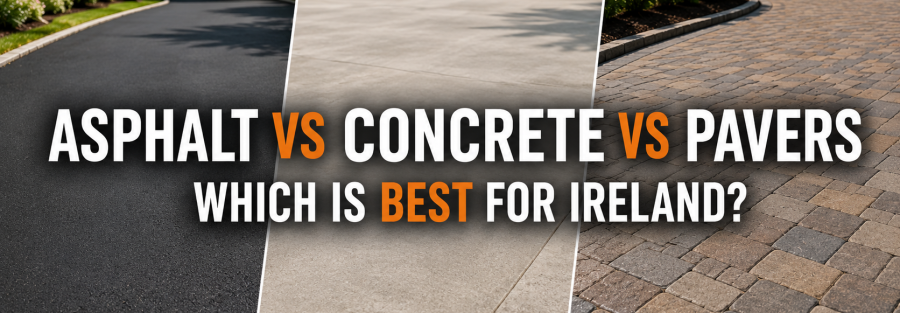
Choosing the right surface for your driveway or hardstanding is an important decision that affects appearance, maintenance, durability and long-term value.
Three of the most common options available to Irish homeowners are:
- Asphalt (commonly known as tarmac)
- Concrete
- Block paving
Each has strengths and weaknesses.
There is no universally “best” option.
The most suitable surface depends on the property’s intended use, budget, aesthetics and long-term maintenance expectations.
This guide compares each material objectively.
Asphalt
Asphalt is widely used for residential driveways due to its relatively low installation cost and quick installation time.
Advantages
- Lower initial cost
- Fast installation
- Smooth driving surface
- Easy to repair locally
- Suitable for large driveways
Disadvantages
- Limited colour options
- Softer during hot weather
- Susceptible to oil staining
- Lower visual appeal than paving
- Typically shorter lifespan than well-constructed paving
Concrete
Concrete provides a solid, durable surface and can be finished in various textures and colours.
Advantages
- Strong structural performance
- Long lifespan
- Wide range of finishes
- Low routine maintenance
Disadvantages
- Cracks are difficult to repair invisibly
- Repairs often remain noticeable
- Can become slippery depending on finish
- Higher replacement costs if defects occur
Block Paving
Block paving remains one of the most popular choices for premium residential driveways.
Individual paving units are laid on a prepared bedding layer and can be lifted individually if future repairs become necessary.
Advantages
- Attractive appearance
- Wide choice of colours and patterns
- Individual blocks can be replaced
- Excellent kerb appeal
- Suitable for complex shapes
Disadvantages
- Higher installation cost
- Weed growth if poorly maintained
- Quality depends heavily on installation
- Poor construction can result in settlement
Which Lasts the Longest?
When installed correctly:
| Surface | Typical Service Life |
|---|---|
| Asphalt | 15–25 years |
| Concrete | 25–40 years |
| Block Paving | 30–50+ years |
Actual lifespan depends far more on construction quality than the surface material itself.
Poor foundations can cause premature failure regardless of the finish.
Maintenance Comparison
| Surface | Maintenance |
|---|---|
| Asphalt | Occasional sealing and repairs |
| Concrete | Low maintenance but difficult to repair |
| Block Paving | Occasional re-sanding, weed control and cleaning |
Cost Comparison
Installation costs vary significantly depending on:
- Ground conditions
- Site access
- Drainage requirements
- Surface area
- Material specification
- Regional labour costs
For this reason, homeowners should compare quotations based on specification rather than headline price alone.
(Natural internal link: “Should I Get Multiple Quotes for Paving Work?”)
Which Adds the Most Value?
From a purely visual perspective, professionally installed block paving generally offers the highest level of kerb appeal.
However, well-executed concrete and asphalt can also provide excellent long-term performance when appropriate for the property.
The quality of workmanship often has a greater influence on property value than the material itself.
Construction Matters More Than Material
One of the biggest misconceptions is that buying a premium material guarantees a premium installation.
It does not.
Sub-base preparation, drainage, edge restraints and workmanship determine whether any paved surface performs successfully over decades.
The Irish Paving Standard recommends assessing construction methodology as carefully as material selection.
Frequently Asked Questions
Is asphalt cheaper than block paving?
Generally yes. Asphalt usually has a lower initial installation cost.
Does block paving last longer than concrete?
Properly constructed block paving can last several decades and has the advantage that individual units can often be replaced without removing the entire surface.
Which surface requires the least maintenance?
Concrete generally requires the least routine maintenance, although repairs can be more difficult if cracking occurs.
Which surface is best for Irish weather?
All three perform well in Irish conditions when installed correctly with appropriate drainage and foundations.
Conclusion
There is no single best surface for every project.
The right choice depends on budget, appearance, expected traffic, maintenance expectations and the quality of construction.
Regardless of the material selected, investing in proper preparation and installation will have a greater impact on long-term performance than the surface finish alone.