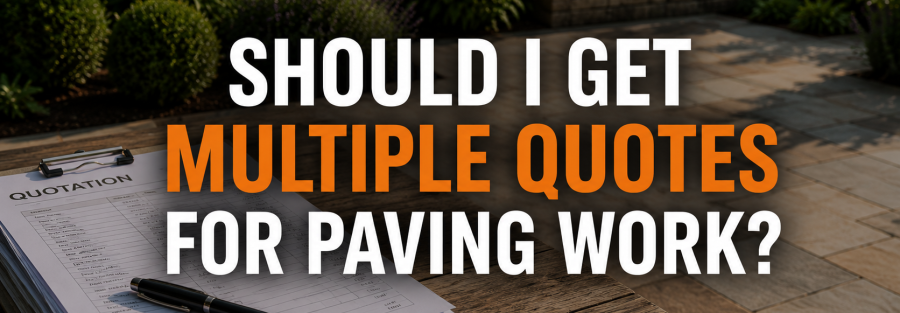
Receiving multiple paving quotations is sensible, but comparing them correctly is far more important than simply choosing the lowest price.
Obtaining multiple quotations is one of the most common pieces of advice given to homeowners planning paving work.
In principle, it’s good advice.
However, many paving disputes begin not because a homeowner received too few quotations, but because they compared them incorrectly.
A quotation is far more than a price. It is a reflection of the contractor’s proposed construction method, materials, quality standards and understanding of the project.
This guide explains why obtaining multiple quotations is recommended and, more importantly, how to assess them properly.
Why Multiple Quotations Are Recommended
Obtaining two or three quotations allows homeowners to:
- Understand the typical market price.
- Compare proposed construction methods.
- Identify differences in specification.
- Assess professionalism and communication.
- Reduce the risk of making an uninformed decision.
Receiving only one quotation makes it difficult to determine whether the proposed solution represents good value.
Equally, obtaining six or seven quotations often creates confusion rather than clarity.
For most domestic paving projects, three detailed quotations are usually sufficient.
The Lowest Price Is Not Always the Best Value
Many homeowners naturally compare the final figure at the bottom of each quotation.
Unfortunately, this can be misleading.
One contractor may include:
- Full excavation.
- A new sub-base.
- Geotextile separation membrane.
- New drainage.
- Premium paving materials.
- Waste removal.
- A written guarantee.
Another quotation may simply allow for laying paving over an existing base.
Both quotations relate to the same patio.
They are not the same project.
The lower quotation may ultimately become the more expensive option if defects develop after construction.
Compare Specifications, Not Just Prices
Every quotation should clearly describe:
Site Preparation
- Excavation depth.
- Disposal of spoil.
- Existing surface removal.
Sub-Base Construction
- Material specification.
- Thickness.
- Compaction method.
Bedding Layer
- Construction method.
- Mortar specification.
- Installation procedure.
Drainage
- Proposed falls.
- Surface water management.
- Drainage channels where applicable.
Edging & Restraints
- Type of edging.
- Method of restraint.
- Fixing details.
Jointing
- Jointing material.
- Joint width.
- Application method.
Guarantees
- Duration.
- What is covered.
- Exclusions.
A comprehensive quotation demonstrates planning.
A vague quotation often creates uncertainty later.
Ask Questions
A reputable contractor should be comfortable explaining:
- Why a particular construction method has been chosen.
- Why specific materials have been recommended.
- How drainage will be managed.
- What happens if unforeseen ground conditions are discovered.
The objective is not to challenge the contractor.
It is to understand the proposal.
Beware of Like-for-Like Assumptions
Homeowners often assume that every contractor is pricing the same scope.
In practice, this is rarely true.
Small differences in specification can significantly affect cost.
Examples include:
- Excavation depth.
- Sub-base thickness.
- Paving thickness.
- Drainage provisions.
- Waste disposal.
- Access arrangements.
Unless each quotation is reviewed carefully, price comparisons can become meaningless.
Consider Professionalism
The quotation itself provides useful information.
Ask yourself:
- Was it clearly presented?
- Was the scope well defined?
- Were exclusions identified?
- Were timescales explained?
- Were questions answered clearly?
Good communication before work begins often reflects good communication during the project.
When Should You Be Concerned?
A quotation may deserve closer scrutiny if:
- The scope is poorly defined.
- Construction methods are not described.
- No allowance is made for drainage.
- There is no written guarantee.
- Large decisions are left undocumented.
These issues do not necessarily indicate poor workmanship, but they increase uncertainty.
Irish Paving Standard Recommendation
The Irish Paving Standard recommends comparing quotations based on construction quality, specification and scope, rather than price alone.
A higher quotation may represent better long-term value if it includes superior preparation, drainage and construction methods.
Likewise, a lower quotation is not automatically poor value if the specification remains appropriate for the project.
The objective should always be to compare like with like.
Frequently Asked Questions
Is it worth getting three paving quotations?
Yes. Three quotations generally provide enough information to understand the market without becoming overwhelmed.
Should I always choose the cheapest quote?
No. A quotation should be assessed on scope, specification, construction method and quality—not price alone.
What should be included in a paving quotation?
At a minimum, the quotation should clearly define excavation, sub-base construction, bedding, drainage, paving materials, edging, jointing, waste removal, guarantees and exclusions.
Can I ask contractors to explain their quotation?
Absolutely. A professional contractor should be willing to explain their proposed construction method and answer reasonable questions.
Conclusion
Obtaining multiple quotations is good practice.
However, the value lies not in collecting prices, but in understanding the differences between them.
A well-prepared quotation demonstrates planning, transparency and professionalism.
Ultimately, the best quotation is rarely the cheapest or the most expensive.
It is the one that clearly explains how the work will be carried out and why that approach has been recommended.
Before accepting any quotation, ensure you understand exactly what is included, what is excluded and how the paving will be constructed. An informed decision at the quotation stage can prevent costly disputes later.