
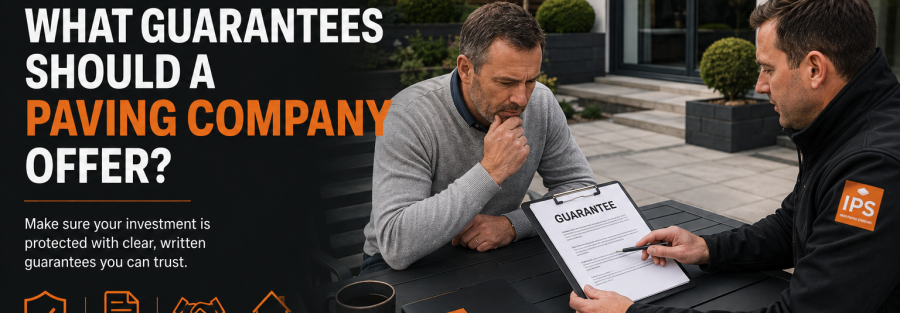
One of the first questions many homeowners ask before hiring a paving contractor is:
“What guarantee do you offer?”
It’s a sensible question, but it’s often the wrong one.
The length of a guarantee tells you very little about the quality of a paving installation. A 10-year guarantee isn’t worth much if the company no longer exists in three years, and a contractor offering a shorter guarantee may actually produce a far superior installation.
The better question is:
What exactly is being guaranteed, and under what conditions?
A professional paving company should be able to explain this clearly before any work begins.
1. Is the Guarantee for Materials, Workmanship or Both?
One of the biggest misunderstandings is assuming every guarantee covers everything.
It doesn’t.
There are generally two separate elements:
- Material guarantees
- Workmanship guarantees
Material guarantees are normally provided by the manufacturer and relate to defects in the paving product itself.
Workmanship guarantees relate to how the paving has been installed.
Understanding the difference is essential because many problems blamed on paving materials are actually installation failures.
2. Does the Guarantee Clearly Define What Is Covered?
A professional guarantee should never rely on vague wording.
Instead, it should clearly define what is covered.
For example:
- Settlement caused by inadequate construction.
- Rocking paving slabs.
- Loose edge restraints.
- Joint failure resulting from poor installation.
- Drainage defects caused by incorrect falls.
Equally important is understanding what is not covered.
Natural weathering, accidental damage, misuse and normal wear should all be explained before construction begins.
Clear expectations prevent disputes later.
3. Does the Company Explain How the Pavement Is Designed to Perform?
A guarantee should never replace good construction.
Instead, it should support it.
Ask your contractor to explain:
- excavation depth,
- sub-base specification,
- bedding construction,
- edge restraints,
- drainage design,
- jointing system.
If these elements are technically sound, the likelihood of future problems reduces significantly.
The best guarantee is often a well-designed pavement.
4. Is the Guarantee Supported by Good Documentation?
Professional companies document their work.
This should include:
- Written quotations.
- Construction specifications.
- Material details.
- Product information.
- Maintenance guidance.
- Any agreed variations during construction.
Good documentation protects both the client and the contractor.
If problems arise later, everyone understands exactly what was originally agreed.
5. Are Manufacturer Guarantees Being Passed On?
Many paving products already carry manufacturer warranties.
Ask whether these will be transferred to you upon completion.
This is particularly important for:
- porcelain paving,
- natural stone,
- jointing compounds,
- drainage systems,
- edging products.
Your contractor should explain which guarantees come directly from manufacturers and which are their own responsibility.
6. Does the Company Explain What Could Void the Guarantee?
No guarantee is unlimited.
For example:
- heavy vehicle loading on pedestrian paving,
- structural alterations,
- pressure washing using inappropriate equipment,
- aggressive chemical cleaning,
- poor maintenance.
A professional contractor should explain these limitations before work begins.
Guarantees should create realistic expectations rather than false confidence.
7. Is Maintenance Clearly Explained?
Every paving surface requires maintenance.
Natural stone may require periodic sealing.
Jointing materials may need occasional attention.
Drainage channels require cleaning.
Ignoring maintenance can reduce the life expectancy of even the best paving installation.
Ask your contractor whether maintenance requirements form part of the guarantee conditions.
8. Does the Company Have a Clear Defects Procedure?
Even the best contractors occasionally need to return to site.
What matters is how they deal with it.
Ask:
- Who should be contacted?
- How quickly are defects inspected?
- What happens next?
- How are repairs documented?
Professional companies generally have a straightforward process.
Unclear answers often indicate the opposite.
9. Is the Company Likely to Still Be Trading?
A guarantee only has value if the company honouring it still exists.
Before appointing a contractor, consider:
- How long have they been trading?
- Do they have a permanent business address?
- Are previous projects available to inspect?
- Do they have a professional website?
- Can they provide references?
Longevity isn’t everything, but established businesses often provide greater confidence.
10. Does the Company Stand Behind Its Work?
Perhaps the most important guarantee isn’t written at all.
It’s attitude.
Professional contractors take pride in their work:
- They explain their construction methods.
- They welcome technical questions.
- They document their process.
- Most importantly, they remain accountable after practical completion.
That level of professionalism is often a stronger indicator of quality than the number of years printed on a guarantee certificate.
Frequently Asked Questions
Is a longer guarantee always better?
No.
The quality of construction is usually far more important than the number of years offered.
Should every paving company provide a written guarantee?
Yes.
Any workmanship guarantee should be provided in writing and clearly explain what is and isn’t covered.
Does a manufacturer guarantee cover poor workmanship?
No.
Manufacturer guarantees generally relate to the paving product itself rather than how it has been installed.
Final Thoughts
Many clients judge a paving company by the length of its guarantee.
A better approach is to judge the quality of the construction that makes the guarantee unlikely to be needed in the first place.
Professional paving is built upon preparation, technical knowledge and consistent workmanship.
When those fundamentals are in place, guarantees become reassurance rather than a safety net.
The best paving companies don’t simply promise quality.
They demonstrate it through their construction methods, documentation and willingness to stand behind their work.